
I need to interrupt my regular scheduled programming to write a little blurb about the new iPhone 4s. I keep reading over and over again how great the camera is in it, especially in low light, but few seem to have compared its pictures to the pictures of anything else. So while the word on the street is that the camera does as good a job as a point and shoot, and that it basically makes having a second camera kind of redundant, nobody’s really shown any substantial evidence to back that up.
I didn’t want to take the tech pundits’ words for it, so tonight I drank a PBR, put the can down next to a cool Vespa calendar in my home of Estes Park, and decided to make my own little comparison. I scrounged up every camera I could get my hands on and took a picture of my PBR/Vespa scene. The list of cameras included the iPad 2, the iPhone 3, the iPhone 4s, Panasonic’s DMC-FX500, Canon’s G9, the Rebel XTi, the 40d, the 5d, and the 5d Mark II. I fitted Canon’s 24-70 f/2.8 L series lens to the dSLRs just to make for a fair comparison. I mean, the optics in a Canon L series lens are about on par with a phone’s camera, right?
I dimmed the lights in the room and created a scene with the following exposure: ISO 800, f/2.4 to 2.8, and 1/15th of a second. Basically, in layman terms, that means there was about as much light as a restaurant at night. Not a dimly lit one, and not a bright fast food place. didn’t use a flash and I shot with Auto White Balance on all the cameras. I actually took the first shots with the Apple phones, imported them into the computer to find out what their exposures were, and set the rest of the cameras to match. I’m sure there are all sorts of people who are going to argue with my methodolgy, but this isn’t really intended to be much more than a rough idea of how these these gadgets stack up against each other.
So what did I find? Well, the pundits are kinda right and kinda wrong. The iPhone 4s’ camera isn’t bad at all — in fact, it’s great (for a camera in a phone) — but I hesitate to compare it to a quality point and shoot, at least in the poor lighting conditions that illuminated my PBR/Vespa scene. Of course the 4s is way better than the iPad, and it’s also significantly better than the iPhone 3, which suffers from a soft lens and heinous color noise in low light situations. But to say it’s as good as a point and shoot is a bit of a stretch. The flash is underpowered and there are no manual controls that would otherwise let you milk a scene for the best results. There’s a fair amount of noise at ISO 800, even compared to my 3 year old Panasonic DMC FX500, and the iPhone lens just can’t compete with the more sophisticated lenses in dedicated cameras.
But — and this is a huge but — there’s something to be said about an 8 megapixel camera stuffed into a smartphone. For everyday purposes, this thing does outdo a point and shoot simply because it’s already in my pocket. And what’s more, in broad daylight, the gap between the iPhone 4s and the point and shoot cameras narrows dramatically (see below). I anticipate it’ll take two to three generations of smartphones to truly close the gap with point and shoot cameras. But meanwhile, I bet you I could make a pretty fancy looking 20×30 canvas print with my new iPhone 4s if I took a picture in well lit conditions.
Anyway, as I expected, the iPhone 4s camera came in just behind my Panasonic DMC FX500 from 2008. It got trounced by the Canon G9 from 2007.
Here are images from all the cameras, roughly resized to the size of the image from the iPad at the top. I realizing that resizing them doesn’t make for a fair comparison, but I’ll leave that to the camera review sites. Hopefully this will give some people a rough idea of how everything compares.
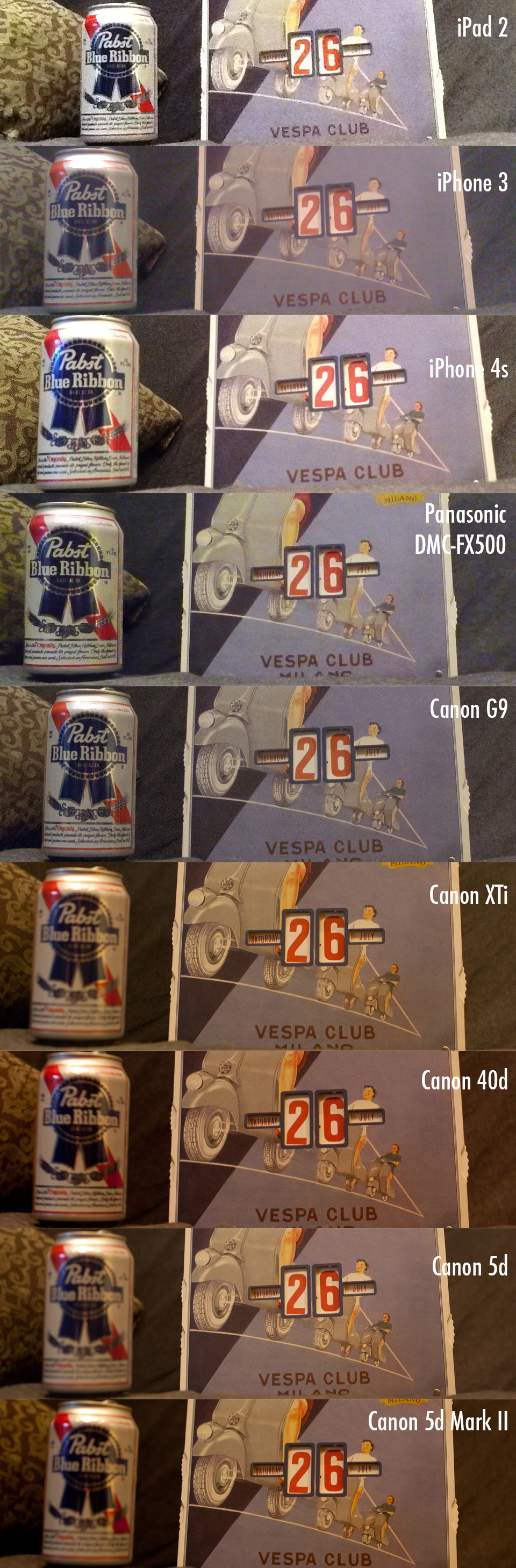
Some general thoughts:
- iPad 2 – The camera is basically a joke. I included it for reference only. It’s less than 1 megapixel and the noise is horrible.
- iPhone 3g – Check out the shadows on the right of the picture and you’ll see the color noise. This is hard to clean up. You can also see, when compared to the image below it, how soft the lens is.
- iPhone 4s – Pretty good, though there’s a lot of shadow noise. The good thing is there’s nowhere near as much color noise as in the images from its predecessor, which is impressive.
- Panasonic – This is the closest competitor to the iPhone 4s camera, but it’s still sharper and cleaner.
- Canons – These are in here just for reference. Notice how tight the grain is on the G9 compared to the iPhone.
I also decided to to check things out in daylight, the results of which are below. Realizing that the only real competitors in my closet were the Canon G9, the Panasonic and the iPhone 3, I left the iPad and dSLRs out. The results were still pretty much the same, though (as expected) the gap in image quality between the cameras narrowed dramatically. The G9 still stands on its own, but the difference between the iPhone 4s and the Panasonic is very narrow. There’s less chroma noise in the 4s, though its grain is really ugly. I found the white balance to be pretty good on the iPhone. Go ahead and click on that below image if you want the full res version.

I was intrigued by how the iPhone stood up to the Panasonic in daylight, so I decided to just take a picture outside to get an idea of what regular snapshot actually looks like. Pretty good, particularly on the web. Again, clicking below will get you a high res version.

But I was a little disappointed by the amount of noise present in the sky, which you can see below at a 100% crop. Otherwise, the lens performed well and is pretty sharp.

Anyway, all in all, not a bad little camera. The iPhone 4s is not a replacement for a point and shoot, but it’s pretty close if you have a cheap one or an old one and you shoot pictures primarily during the day. If you are traveling and want a good camera for your trips, consider investing in a good, modern point and shoot.
Now, enough pixel peeping. Back to the fun stuff: people getting married!
I am looking forward to testing out the 4S myself as i have heard it produces sharper pictures and reduces noise , great article .
The pictures seem to speak for themselves the 4S looks good !
YOu can look on my flickr account for a comparison 🙂
I’ll probably stick with the 5D mk2 for weddings although it would be funny to pull out an iPad just to see their faces
I’m a big fan of the iPhone 4S camera. These pictures really show how clear it is! The accessories you can get for it are amazing too. The Olloclip is genius…
Perfectly composed subject material, thanks for selective information. “You can do very little with faith, but you can do nothing without it.” by Samuel Butler.